

If time proves to be not just malleable, but revisitable, we can close our eyes and be back in a tiny Lancashire hamlet called Tockholes; graced by a pub, a few stone cottages and a car park/bus turnaround of the farthest route from Bolton’s bus station, on Moor Lane, in the town centre.
Had my share of nightmares, didn’t think there could be much more
Then in walked Rodrick Usher with the Lady Eleanor…
The car park’s sole occupant is a Ducati 250cc single-cylinder motorbike. It’s not new, but it’s a lovely, metallic mid-blue and silver, and this is the first outing of its new life with a sixteen-year old who has just passed his bike test.

The boy and bike are on an inaugural celebration run to mark their pairing – provided by the lad’s father to mark success at the GCE exams, at which he’s just done quite well.
She tied my eyes with ribbon of a silken ghostly thread
I gazed with trouble vision on an old four poster bed
He’s not with the bike, though it brought him here and sits in the pub car park, polished and gleaming as much as a six-year old machine can.
He’s here – in Tockholes – because, on a previous occasion, it was on the way here in the family car that he first heard a piece of music so powerful that he feels it changed his young life … and he had dreamed that, if he passed his exams and his bike test, he would come here and celebrate with a flask of hot tea and a Turkish Delight chocolate bar … at his favourite ‘me-spot’ by the lakeside, below.
The place where he first sang to The Lady Eleanor.

It’s a ten-minute descent from the pub’s car park to the lake. He’s been singing to himself the whole way. The volume of his singing increases as the water comes into view – calm and beautiful… and receptive; as though the lake is listening.
And the Lady of this lake is Lady Eleanor … and she listens to the boy singing and accepts his tribute. The valley resonates with the exchange.
Life is good. Very, very good.
Last Saturday, the creators of the Lady Eleanor song – the still-performing group Lindisfarne – came to The Platform concert venue in Morecambe.
The sixteen year old young man was there …
and so was his Lady Eleanor …
Here’s a YouTube video if you’d like to warm those memories…

©️Stephen Tanham, 2025.
Share this:


The lovely Park Road Gardens, in Grange-over-Sands is one of the jewels of the Cumbrian coast of Morecambe Bay.
I like to photograph it through the seasons.

Through November, it completes its departure as a summer haven and takes on a beautifully melancholy palette of fading golds.

One other transformation is unexpected. A hidden path from a former iteration of the park’s design opens up to reveal a clear view down to the promenade and shore.
Although only a short distance to the sea, the old path would now cross the main Barrow-in-Furness railway line … so you can see why it was horticulturally concealed- to discourage children from trying!
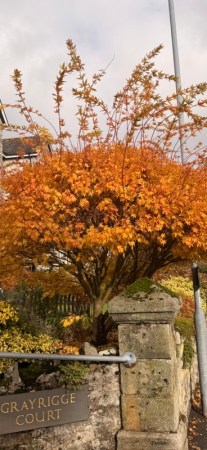
There is though that lovely feeling of having uncovered a phase of local history.
©️Stephen Tanham, 2025
Share this:


The small seaside village of Arnside seldom disappoints in providing us photographers with scenes animated by extraordinary light.
Facing west out into the northern end of Morecambe Bay the estuary features complex tides, the outflowing confluence of three local rivers, and some of the most spectacular skies in Britain.
We even have our own ‘bore’, much like the River Severn, but considerably smaller in amplitude.
The sky is the constantly-changing star. There is always so much energy up there that no visual moment can be guaranteed to last. If you see it, take it has to be the sentiment.
This shot was taken mid-afternoon, when the light was dropping like a stone. In the resulting gloom – which had painted the village a seeming coal-black – there emerged a fluffy tunnel of golden light.
As taken. No filters or effects.
©️Stephen Tanham. All work by the author.
Share this:

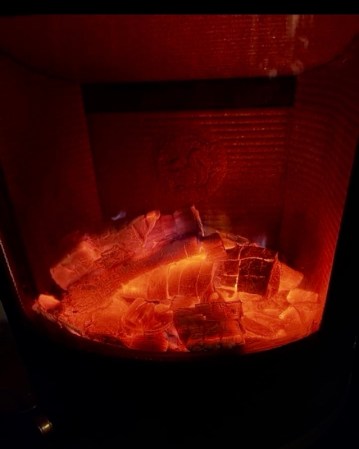
Time-travelled fragments
of mittened fingers
Held in firm parental hand
Exploding neighbours’ gardens
Ripe with bangs and secretly given
toffee-apples
Eyes that glistened with a million smiles
And a few deep breaths as
Imagination proved secondary
To ruptured air obeying gunpowder’s plot
So long ago, now
Yet
In these simpler flames
Where logs surrender to stealthy heat
And memory is escorted, glowing
It remains in vibrant view
A glorious recollection
Of children’s delight.
~~~~~~~o~~~~~~~
Share this:


A dear friend sent this to me a few days ago. In a year that’s been very emotional, it touched me deeply, and I thought I’d share it here:
‘The Taker of the Photos
‘I am the taker of the photos. I am the receiver of the groans, the eye-rolls and the “hurry ups”.
I am the one who disrupts the moments – to capture them. But I am also the holder of the memories, I am the keeper of the stories. I am the one with the precious proof.
And if you are too, please know you are capturing this life as it happens. Capturing stages, ages, twists, turns and final moments no one could have forseen. The eye-rolls will be replaced one day with absolute all-consuming gratitude for the image of a smiling face so missed and a memory returned home to stay.
Keep disrupting life to capture it, my friends. When it’s all that’s left, someone, somewhere, will be so very glad you did.’
Donna Ashworth
Joy Chose You
Share this:


The crunch-crackle…
I’ll bet you can hear it in your head!
Image by the author.
©️Stephen Tanham
Share this:


Part one: eternal stone
A canvas on which the far future writes.
Part two: life abundant, free divergence.
Part three: Fragment of a moment in which intelligence passed this way, a quarter-second behind reality.
©️Stephen Tanham, 2025
Share this:


There’s always one day in October that epitomises that golden sense of the final goodbye to the summer for another year.
A visit to Grange always entails a short collie-walk in the Park Road Gardens, which are beautifully kept and a treat for any season. Tess is nearly eleven, and such strolls are ideal for her ageing joints…
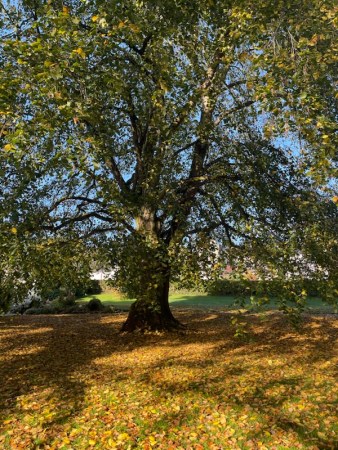
Today was it, and we were lucky enough to be doing the weekly shop in Grange-over-Sands when the sun burst through with all its October mellowness, lighting not only the pale greens of the departing leaves, but also the seemingly endless carpet of gold beneath.
The winter is just around the corner, of course. But this immersion in glorious gold is very welcome!
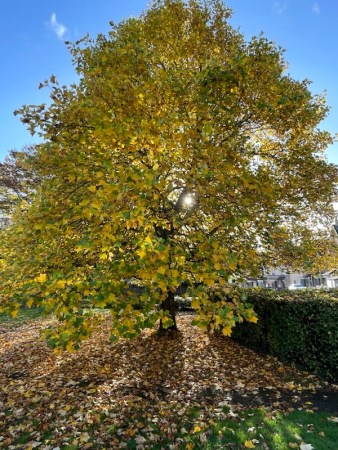
Photos by the author. ©️Copyright Stephen Tanham, 2025.
Share this:

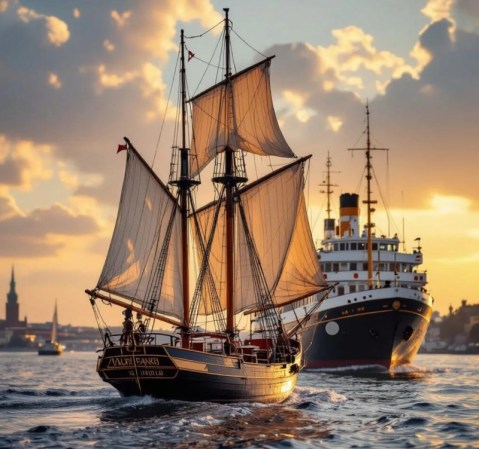
The flight from Montreal had been short and pleasant. Through the aircraft’s small window, the pastoral landscape of Prince Edward Island (PEI) was expanding into detailed view as our plane from Montreal jostled with the final air currents and descended to land at Charlottetown, the island’s capital.
Below us stretched the gentle hills and estuaries of PEI, many of which we would encounter, albeit by short outings from the capital, in the few days that followed on this, the last part of our Canadian trip.





Four days later, we felt we had at least sampled life here and enjoyed it very much. Charlottetown, the island’s capital and our base, offered a lovely quayside walk into it’s historic town centre, a stroll taken in search of dinner each evening when we returned to our guest house a little weary from so much driving and exploring.
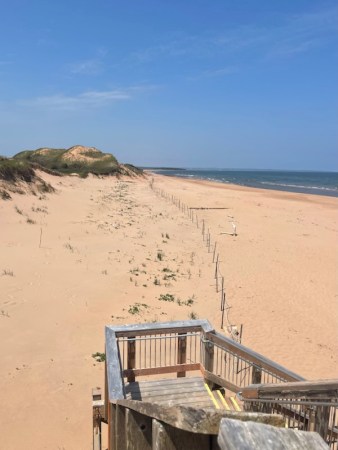
We were saving the final day for something special. The penultimate one saw us explore some of the bays and beaches on the north of PEI, and we closed off the day by spending a few hours exploring Bernie’s long-awaited Green Gables Heritage museum.
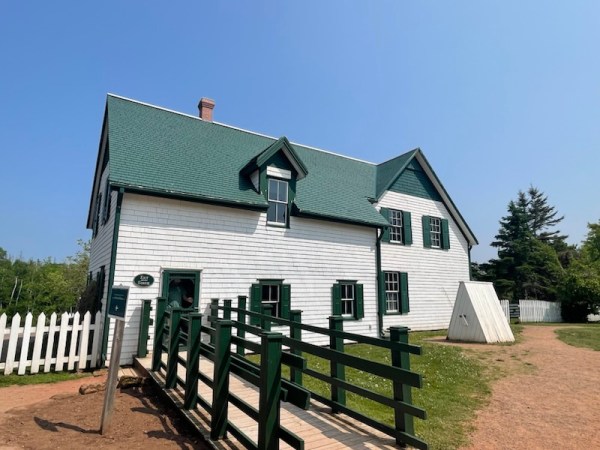


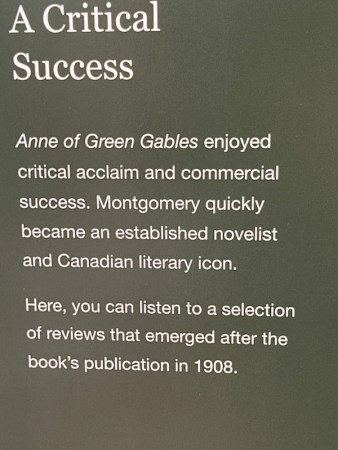

For now, (above) here’s a montage of some of the interesting panels of both author and characters…
Bernie remembers loving these books as a child. She hadn’t expected to visit the place of their origin, here on Prince Edward Island. For her, this visit, alone was worth the trip.

Back to the conclusion of the main story…
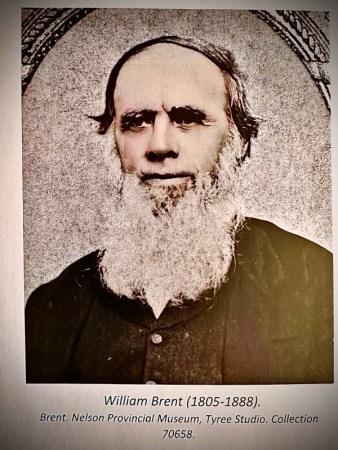
Russ and Paul’s ancestor, William Brent, had taken his final voyage aboard a boat built for them somewhere on Prince Edward Island. They were to use it for the final part of their emigration from Cornwall to New Zealand – a considerable undertaking … and one filled with risk!
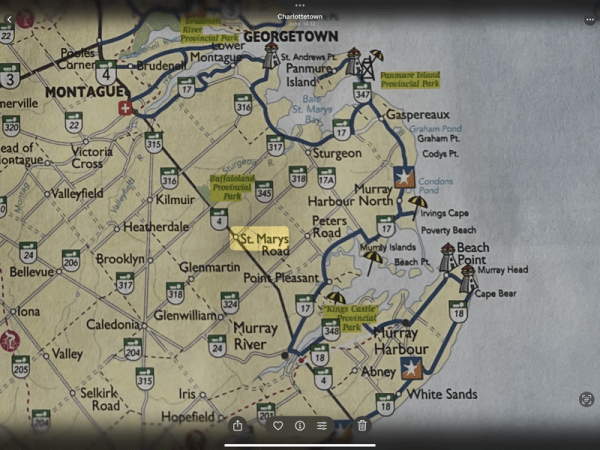
The end of our trip was fast approaching. We had set aside the final full day to travel to St Mary’s Bay – a huge estuary from some point in which Russ’s ancestors had departed for their new life aboard the Lady Grey, a schooner built for them on PEI for the purpose – presumably with their life savings.
At that time, PEI was a renowned centre of timber production and boat building. But there were no surviving records as to where the schooner had been constructed – beyond that it had been somewhere in St Mary’s Bay – a large area!
There were many small docks in St Mary’s Bay and we had no chance of searching them all. Also, we had been warned that many of them were recent and unlikely to have been connected with the building of ‘our boat’.

Our last day was to be spent in the hopeful fulfilment of our promise to Russ – the direct descendant of William Brent (see previous posts).
He had asked no more than we take a few photos of PEI, to add to his family records back in New Zealand. But we felt we could do more, as long as the ‘fates’ were on our side… In reality, we had almost no chance of finding the location, so long after the event.

Taking general photographs of PEI was simple but we thought that we could do better than just take snaps of the general scenery. We both felt this, strongly, but had no idea why we felt that confidence.
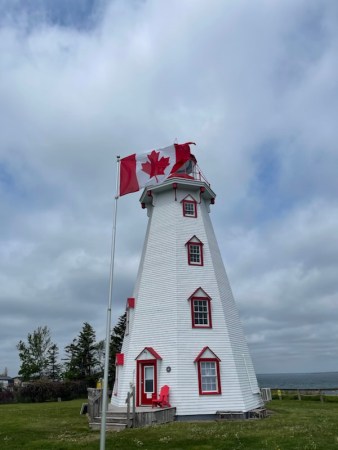
I confess to having a general strategy on such occasions; if there’s a lighthouse, I head for it… Apart from a love of photographing lighthouses, other good things occasionally happen…and there’s a hopefulness about lighthouses!

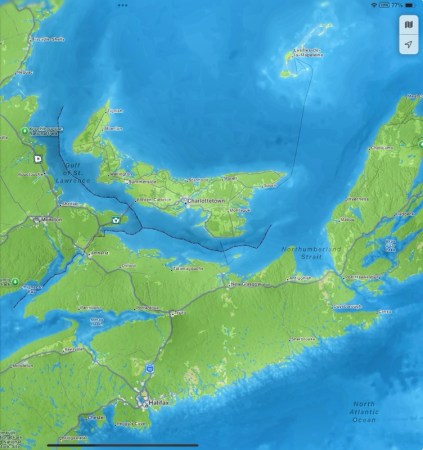
Local maps revealed that the western edge of St Mary’s Bay was bounded by a long causeway at the end of which was a larger piece of land named Panmure Island (see map below).
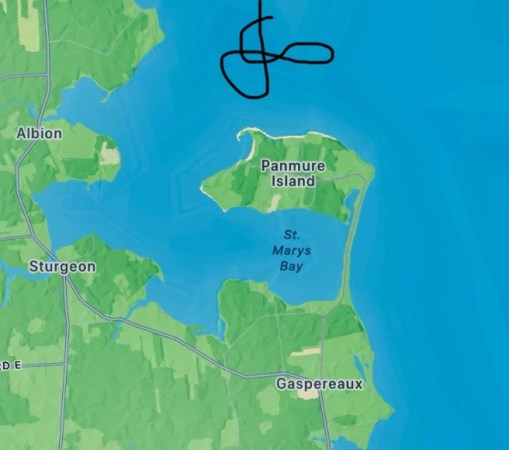
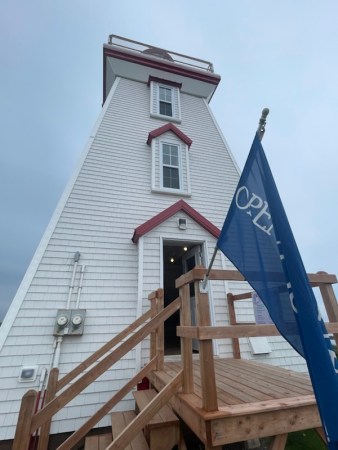
The lighthouse (as photo earlier) was located here, facing the ocean, literally the last piece of land the Lady Grey would have passed on her way out into the open sea. Surely this would be a more meaningful photo-set for Russ and Paul?
The journey took us an hour from our guest-house in Charlottetown. Once there, we spent a cold twenty minutes exploring the small headland before gratefully getting back into the car and retreating down the causeway … where we remembered seeing a cafe!
It had been a while since breakfast. We were glad to make the stop and relieved to find that though the cafe was closed, there was a ‘take-away’ hatch in the wall!
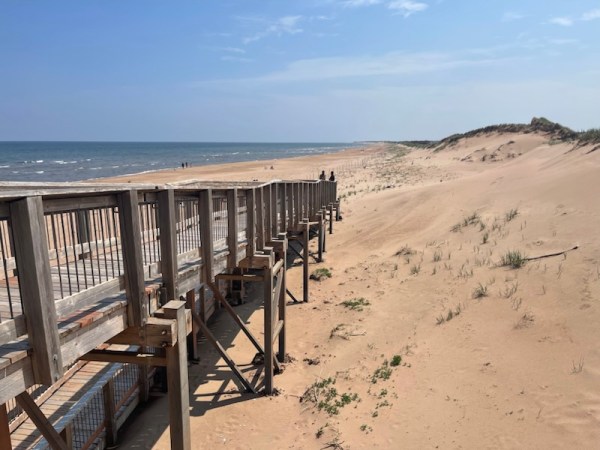
There was a tall observation platform. I climbed up to take some shots of the beach and ocean. Here was a perfect balance of estuary on one side and the open Atlantic on the other; both visible from the viewing deck.
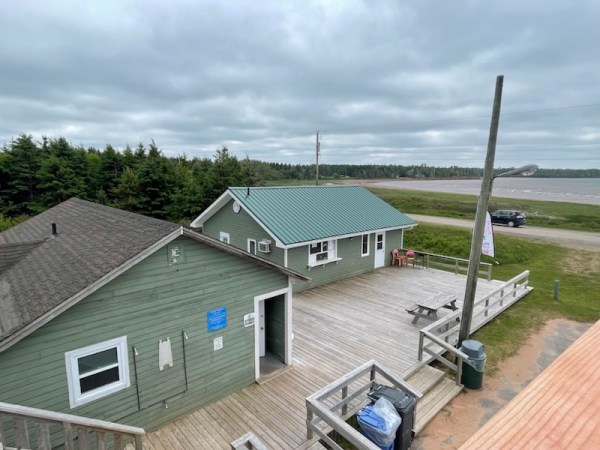


I began to get that ‘gently buzzing head’ feeling that tells you something extraordinary is about to happen.
I looked down from the viewing deck to see Bernie talking to two young people in blue polo shirts. It turned out they were the local Park Rangers and were keen to help us, being fascinated by Bernie’s retelling of the story of The Lady Grey. We explained our thinking that we had probably got as close as we could to the distant past of William Brent and his family.
They were both interested in The Lady Grey and asked us to tell them more about its origination, here.
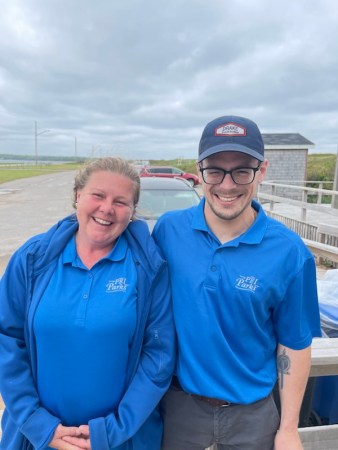
They knew the history of Panmure Island and explained that there were only two boatbuilders here in the 1820’s and both of them operated from the old quays. They pointed us back the way we had come – along the causeway, again – and beyond the turning for the lighthouse – which we had taken for a forest track leading nowhere. They assured us that the track widened and would take us onto the Panmure Island coast and there we would see the remains of the boatbuilder’s quayside.
They were certain that the Lady Grey would have been constructed there, as the ship-building operation had been substantial – and it gave direct access to the deep tidal flows necessary to launch such a ship into the estuary for final fitting before its maiden voyage out into the nearby Atlantic Ocean.
We drove in silent excitement back across the causeway…
Approaching the lighthouse, again, we could see the small track we had missed. We took it and, soon, another landscape of red sand and forest opened up before us.
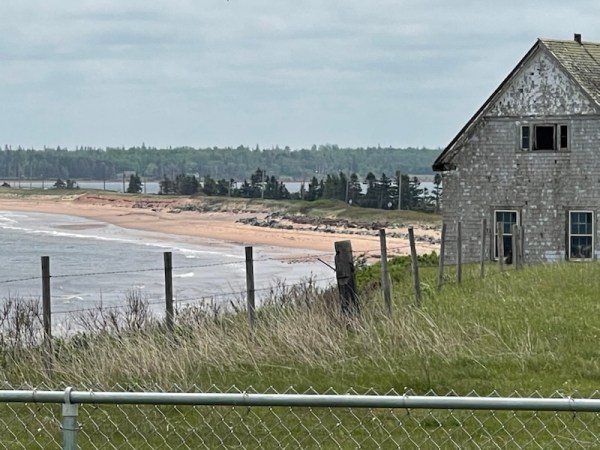
Less than 100 metres in, we came across the sea-washed remains of the old quays, long abandoned…

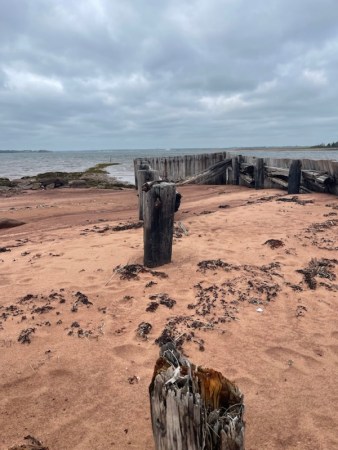


So, now Russ and Paul have their photo souvenirs and – via the Rangers – accurate and verified contact with the past.
And we feel pleased that we were able to provide more details of the the missing piece of Russ and Paul’s family story – Prince Edward Island.


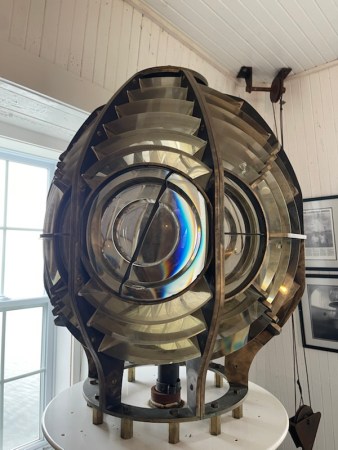

©️Copyright Stephen Tanham, 2025.

Share this:


(Continued from Part One)
Prince Edward Island, often shortened to its initials PEI, is Canada’s smallest province. It lies only 13 miles off the New Brunswick Atlantic coast. It is connected to the Canadian mainland by one of the world’s longest bridges to pass over ice-covered waters (in winter), named the Confederation Bridge.
It is one of Canada’s Maritime Provinces, and the waters that flow around it are those of the Gulf of St. Lawrence. To the south is the Nova Scotia peninsula.
The island has an excellent and friendly airport to look after tens of thousands who come to visit the home of their favourite childhood character.

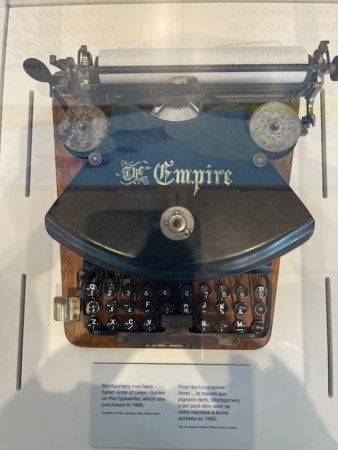
PEI was the home of L. M. Montgomery, the best-selling author who created the Anne of Green Gables series of books, in its time, among the world’s most popular books for teens.
Long before the Anne of Green Gables books, it was the new home of William Brent and his family, after their successful schooner voyage from Bideford in North Devon – See Part One.
The outline of William Brent’s two amazing voyages was told in the previous post. In this blog, we consider some of the underlying conditions of the time: the backdrop to William Brent’s decisions.
Thomas Bernard, a relative of William Brent from Britain, had been on Prince Edward Island for many years before William Brent arrived with his family in the late 1820s.
Thomas Bernard’s business had two operations; they had established themselves as one of PEI’s major shippers, using their extensive knowledge of the Atlantic Ocean and its main ports, and secondly, they were poised to inject a very familiar ‘new’ cargo into those supply lines – quality timber.
Prince Edward Island was sparsely populated and had plenty of timber – though the land was unforgiving and less productive as a basis for agriculture. PEI, being a maritime province, had an existing reputation for quality ship building, and was growing in nautical importance despite the extremes of weather during the winters.
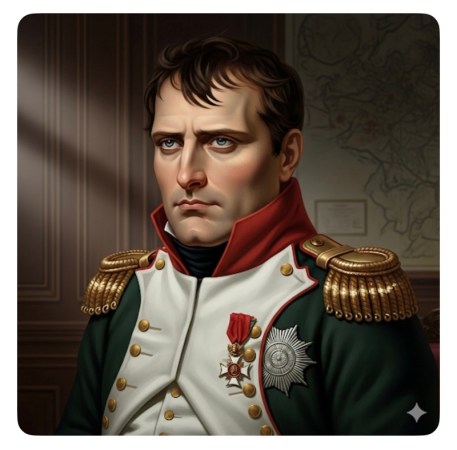
Thomas Bernard was aware how political tensions created markets. The self-styled French emperor, Napoleon Bonaparte, saw the British as his primary enemy.
Bonaparte, furious at Britain’s continued domination of the seas via their superior Royal Navy – used the smaller French fleet to blockade the Baltic ports, preventing the vital supply of raw timber Britain needed to maintain and increase ships of the fleet.

with comfortable soldiers’ living quarters on four floors. On the roof, was a rotary iron track around which the main cannon could be accurately aligned- enabling any ship within Scapa Flow to be targeted.)
The Hoy Martello Tower was never used in anger. But it did help to establish the vast Sea-Loch of Scapa Flow as one of the Royal Navy’s most defensible waterways. In addition, in Thomas Bernard’s time, the vast Scapa Flow sea loch was used as faster route to the open Atlantic, and therefore allowed Napoleon the possibility of ambush of timber shipping.
Napoleon Bonaparte was a thinker … and the presence of the Martello Towers would have weighed heavily on any considerations of a British Invasion by the French. A single, accurate, canon shot from this formidable weapon could sink a ship.

Over 100 Martello towers were made along England’s south and east coasts between 1805 and 1812.
None were ever fired in anger – an early example of ‘deterrence’ at work on a geo-political scale.
William Brent was a relative of Thomas Bernard. He saw his chance to take a low-risk move to PEI, moving his family from Cornwall to Prince Edward Island to join the carpentry operations of the relative Thomas Burnard.
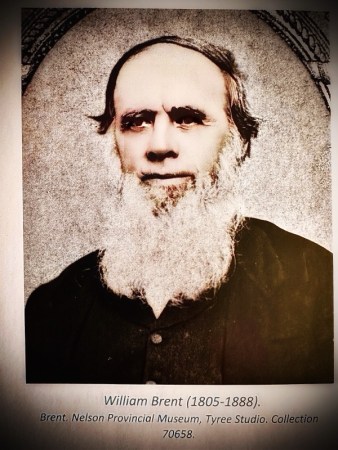
His advanced carpentry skills were in wider demand. He built his own house, then was instrumental in the design and building of a local church – one of the first on PEI, thus firmly establishing himself at the heart of the Charlottesville community.
‘Back in the present’, the research was going well – continually aided by Paul and Russ’ historical facts and the right kind of summaries that help the story; no-one wants a list of facts!
The start of our trip to Canada to see the family was fast approaching. We had to plan carefully. Family time had to be the first priority… but after that…
Bernie had arranged a long-overdue reunion in Ottawa with one of her cousins, Lee. Lee’s family had travelled, luxuriously, around the world in the 1960-70s, moving as part of their father’s career as a senior Shell Oil executive.
Bernie and Lee hadn’t seen each other in 53 years, though they had kept in touch.
Lee now works for the government in Ottawa and was keen to show us around that fine city. That, she said, would take us a full day – with some social time mixed in for lunch and dinner.

After leaving Toronto, Lee would collect us from the railway station in Ottawa and was and put her heart into the task of genial host for our two days there – far too little time for such a beautiful city.
That left a few days on PEI at the end of the trip…where we hoped to be of use to Russ and Paul in providing at least some ‘feel’ of St Mary’s Bay – the place where their new ship – The Lady Grey schooner had been built. We wondered if there might be one or two photographs of the harbours in use on the eastern seaboard, especially those that may have had the skills to take on the building of an entire ocean-crossing schooner, back in the 1820s … it was a long-shot.
Upon our arrival, two days would be devoted to getting to know the layout and scale of PEI by rental car. Our travel experience had shown the importance of that!
We’d allocated a full day for having a good look at The Anne of Green Gables visitor centre – on which I would like to invite my wife do do a separate post, using this blog.
The final day would be an attempt to do justice to our historical mission – To locate and explore St Mary’s Bay, the place at which the Brent family’s new boat: The Lady Grey, was constructed; the place from which they had sailed into the relative unknown, successfully crossing the oceans to New Zealand in the early years of the 18th century.
Russ had only asked us to take some general photos of PEI, for use in he and Paul’s historical research. But I had the feeling that we could get closer
A sidewards skirmish via the internet had revealed that PEI had a fine set of lighthouses – one of my favourite subjects to photograph. I hoped to feature one or two photographs as we went along.

The airport gate was shortly to close. It was time to leave mainland Canada behind, though we would eventually connect to Dublin and Manchester via a swift return to Toronto.
Was it reasonable to presume we could have any success at all? Photos a friend had supplied made it look sparsely-populated. Fishing trips seemed to be a major business – with a few cafes and farm shops close to major road intersections.
We could only try…

And at least the photography would be plentiful…

Below is one of very few documents related to The Lady Grey, built somewhere in St Mary’s Bay. It comes from the shipping register of New Zealand and is dated after the ship was subsequently sold. . Details of the ship are well documented, and it fulfilled its twin roles of transporting the Brent’s safely to New Zealand, and providing the initial capital for their lives.
They never moved again…

For us to find anything meaningful – and of use to assist Russ and Paul – we were going need much more than logic.We would need that telling intervention of serendipity- luck.
To be concluded in Part Three.
©️Copyright Stephen Tanham, 2025. Photos by the author.
Share this:

+ #iphonephotography, #Photography,, #Silenti, Ancient Landscapes, Consciousness, Mindfulness, Nature and seasons
The soft and clear light of September
by Steve Tanham

September one of my favourite months, though I’m always sad to see the summer end.
September is a kind of ‘transition zone’ between the golden end of the warm months and their colder counterparts that live on the edge of true winter.
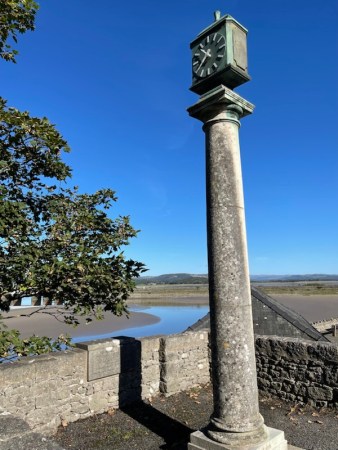
For us on the southern edge of the Lake District, it’s a time when, on the right clear-skied morning, getting the dog up and out early can pay dividends in the form of clear shots with a hint of mellowness.
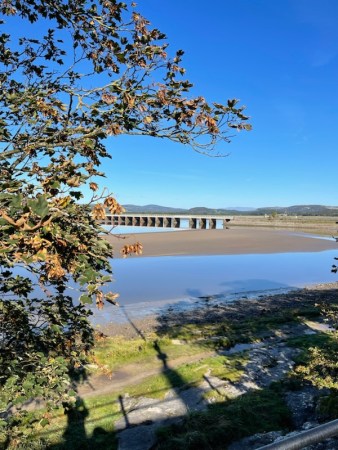
The incoming colder days lend a clarity to the morning sky, one that is often ‘hazed’ in warmer months.
And we’re lucky to have Arnside close by, with its rich mixtures of estuary, sandbanks and that ever-present rail viaduct; the lifeline for the folks from Barrow and Ulverston and beyond
Deep blues, clear skies and historic objects – including this tall clock that hasn’t worked for years, yet has a loyal band of supporters.
©️Stephen Tanham, 2025
Share this:

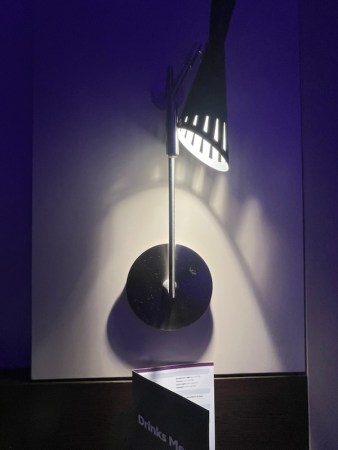
“You’re staring at that lamp.”
“Yes.”
“You’ve been staring at that lamp for twenty-three minutes, now.”
“Twenty four, actually. I’m counting as well as staring at the lamp.”
“Why are you staring at the lamp at 11:30 in the evening when we’re on holiday in Dublin?”
“Because it’s a peaceful shape with soft curves and relaxing shades of white, grey and silver.”
“Just because it’s relaxing? Isn’t falling asleep relaxing, too?”
“It wasn’t bothering you till you noticed… You were peacefully reading your book!”
“Are you meditating? Is this some new form of meditation you’ve adopted”
“Staring at lamps?”
“Yes!”
“No. I just like this lamp at this time and in this place…”
“You’ve always been weird.”
“Possibly, but it’s never been done to generate an argument. How’s the book.”
“It’s … was very good.”
“And my staring, peacefully at the lamp has changed its ‘goodness’?”
“Goodnight!”
———————
Penned for Pensitivity’s Three Things Challenge


 Sun in Gemini
You must be logged in to post a comment.